The story of 1960s evening dress is often told as a simple liberation narrative: women were trapped in rigid gowns, and then the decade arrived and set them free. The reality is more complicated, and more interesting.
Structure, Propriety and the Hourglass Silhouette
Formal dress before the 1960s was genuinely structured. The hourglass silhouette was dominant, supported by corseted undergarments and stiff fabrics. Gloves, heels, and carefully styled hair completed a look oriented toward social propriety rather than personal expression. But this wasn’t the whole picture.
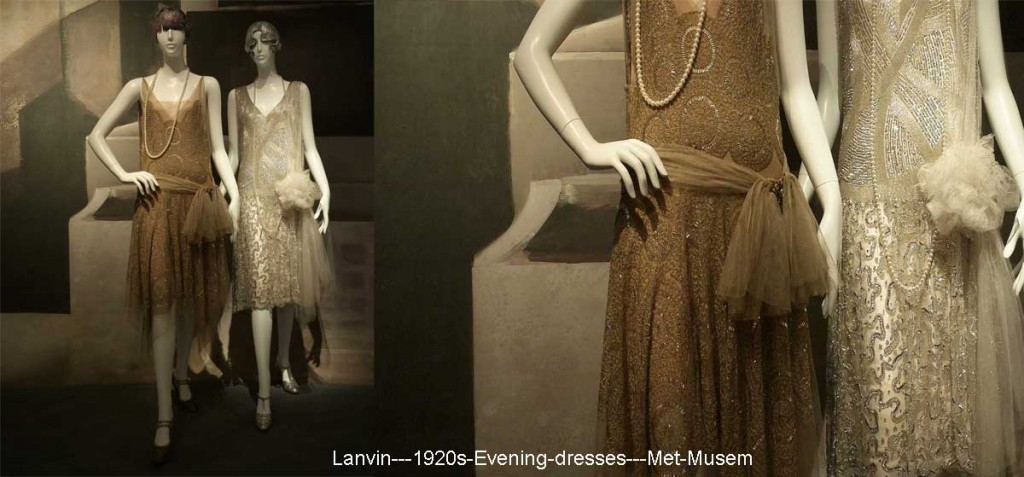
The 1920s had already introduced radical silhouette shifts – dropped waists, shorter hems, bare arms. The 1930s brought Madeleine Vionnet’s bias cut, which moved with the body in ways that structured couture never had. Marlene Dietrich and Katharine Hepburn were wearing tailored trousers in public from the 1930s onward. Wartime necessity brought trouser-wearing into the mainstream for many women long before the 1960s arrived. The 1950s added its own chapter: Dior’s New Look reshaped the postwar silhouette entirely, and Balenciaga was already beginning to move away from the fitted hourglass – his 1950s tunic and sack silhouettes loosened the relationship between garment and body in ways that would become more pronounced in the following decade. Constraint and creativity coexisted.
The Generation That Dressed on Its Own Terms
What the 1960s did was accelerate and formalise changes already decades in motion – and shift who was driving them.
Youth culture, growing female independence, and expanding professional opportunities created a different set of demands on clothing. The generation coming of age in the early 1960s was less interested in dressing to a prescribed image of refinement and more interested in dressing on their own terms. Designers responded, and in some cases led. The women’s liberation movement would gather momentum later in the decade – Betty Friedan’s The Feminine Mystique appeared in 1963, and organised activism accelerated from the mid-1960s onward – but the cultural mood that preceded it was already reshaping what women wanted to wear.
The Minidress: A Hemline With a Longer History Than You Think
The hemline shift is the most visible marker of the decade, but its origins are harder to pin down than the standard narrative suggests. The 1940s beach skirt – a short, casual garment already in circulation – had quietly normalised above-the-knee hemlines in informal contexts long before the 1960s made them a cultural flashpoint.
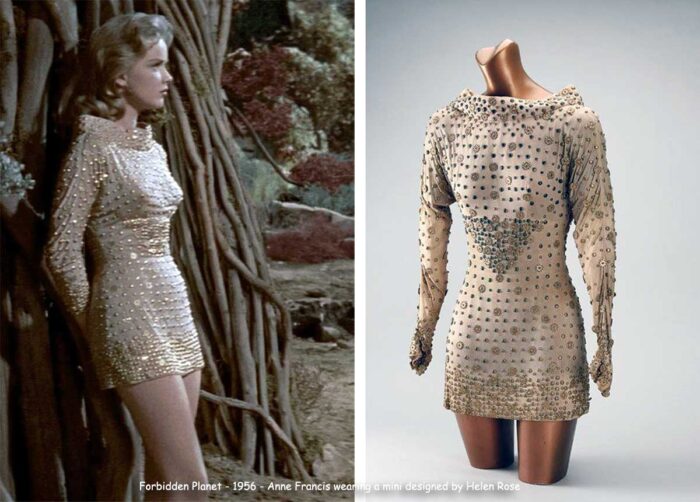
In film, the case is even more striking: Anne Francis wore a series of jewelled mini dresses in the 1956 science fiction film Forbidden Planet, every one of them designed by costumer Helen Rose. Rose has received almost no credit in the miniskirt conversation, which is an oversight worth correcting. When the miniskirt became a phenomenon in the 1960s, André Courrèges deserves the strongest claim to bringing it into fashion as a deliberate design statement – his 1964 Space Age collection gave it architectural rigour and cultural weight.
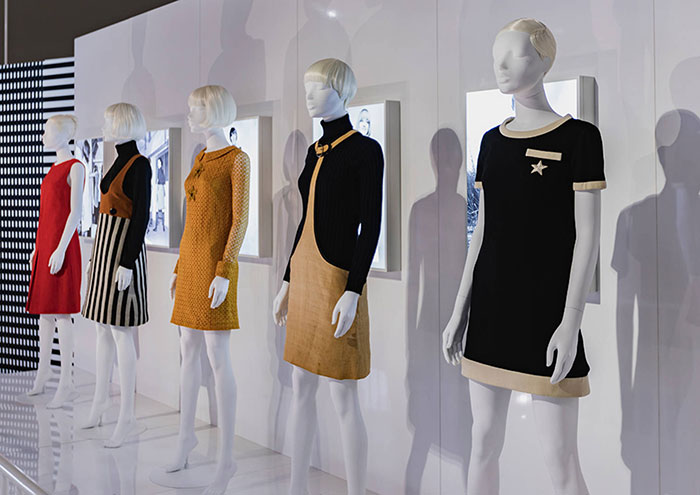
Mary Quant’s King’s Road boutique amplified it and made it a symbol of youthful London energy. Neither invented it from nothing. The hemline had been travelling upward for decades.
Pattern, Tailoring and the New Language of Evening Dress
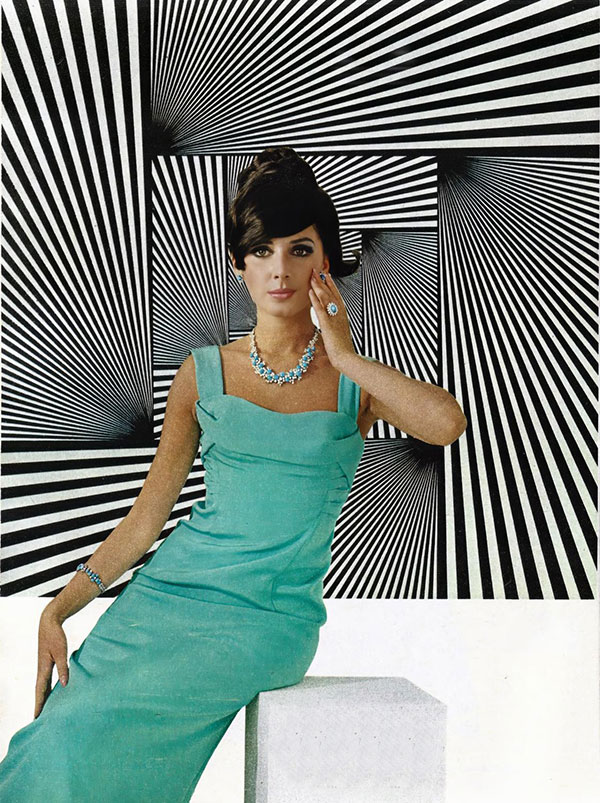
Colour and pattern shifted in parallel. The muted, controlled palettes of much postwar eveningwear gave way to bolder combinations – geometric prints, graphic florals, high-contrast colour blocking influenced by Op Art and Pop Art. This wasn’t entirely new; Elsa Schiaparelli had been working with surrealist prints and vivid colour since the 1930s. But the 1960s pushed these ideas into mainstream eveningwear at a scale and speed that earlier decades hadn’t managed.
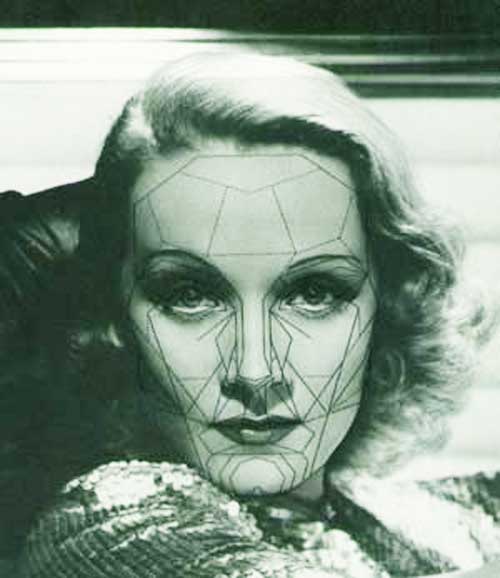
Tailoring underwent a similar shift. Women adopting structured suits and sharp separates for evening occasions wasn’t a departure from tradition so much as the formalisation of one. Marlene Dietrich and Hepburn had already established that tailored dressing was possible; what changed in the 1960s was the intent. A tailored evening look now read as a deliberate statement rather than a functional wartime compromise or a personal eccentricity. It wasn’t an imitation of menswear. It was a redefinition of what elegance could look like.
When Formal Dress Stopped Having One Answer
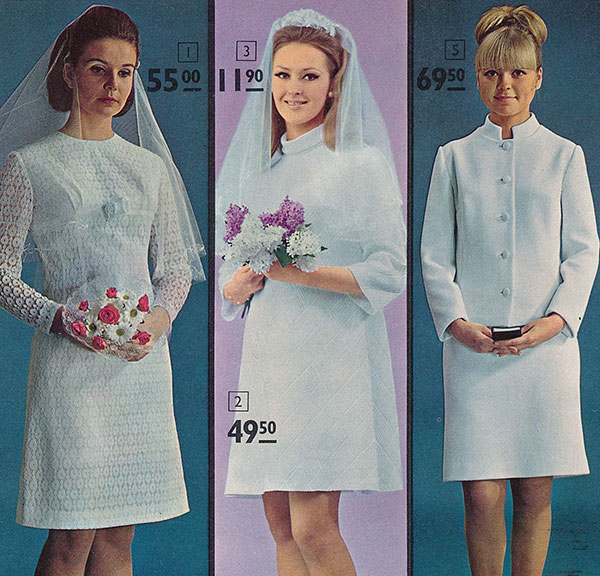
That pluralism extended into occasions previously governed by the strictest conventions. Wedding dress codes are a useful measure. Guest expectations had long been shaped by class, region, and social circle rather than any single universal rule, but within those varying contexts the range of what was considered appropriate had remained narrow. The loosening of norms across the decade gradually widened that range. Mother of the Bride dresses today reflect exactly that inheritance – a category defined not by a single prescribed silhouette but by genuine breadth: shorter cuts, bold colour, relaxed tailoring, all considered equally appropriate for the occasion.
The lasting effect of all this wasn’t simply that hemlines rose or colours brightened. It was that eveningwear became genuinely plural. By the end of the decade, there was no single silhouette a woman was expected to wear to a formal occasion. Today, the popularity of structured evening separates is yet another legacy of pantsuits vogue which quietly slipped in near the end of the 1960s decade. That openness – the idea that formal dress could express individuality rather than suppress it – is the real inheritance of the 1960s, and it remains the foundation of how eveningwear works today.
That’s all ! © Glamourdaze