I’ve always been a bit obsessed with the idea of time travel. Not the sci-fi kind with DeLoreans and flux capacitors (though I’m not opposed), but the kind where you can peer through a window into another era and actually see it—feel it, even. When I stumbled upon this rare silent film footage from the Jazz Age Paris circa 1930, I knew I had to bring it to life This wasn’t just any footage; it was a crystallised snapshot of Paris in the Jazz Age, that intoxicating period the French call Les Années folles—the Crazy Years.
Silent Paris Footage from the Jazz Age is Brought to Life
The original silent BW footage is from the National Archives. Now you can see the full 4K colour and sound enhanced footage in action. Check out the video on Glamourdaze YouTube channel !
What you’re seeing here is my attempt to restore this archival treasure to a form that feels almost touchable. Every frame has been meticulously colour-graded to reflect the actual tones and textiles of 1930 Parisian fashion. I’ve added historically accurate sound—or as accurate as my research can tell—from the hum of early Citroëns to the chatter of sidewalk cafés. And yes, I even adjusted the original 20fps silent frame rate to a buttery-smooth 60fps so you can lose yourself in it.
Here’s how seven ordinary Parisians stepped out of the shadows and into vivid colour.
The Mother and Child in the Park: Quiet Sunday Elegance
This one stopped me in my tracks. A Parisian woman sits on a chair in the Luxembourg Gardens, her young daughter playing at her feet. In the original black-and-white footage, she’s just a blur—a ghost, really. But once I brought her into colour, she became real.
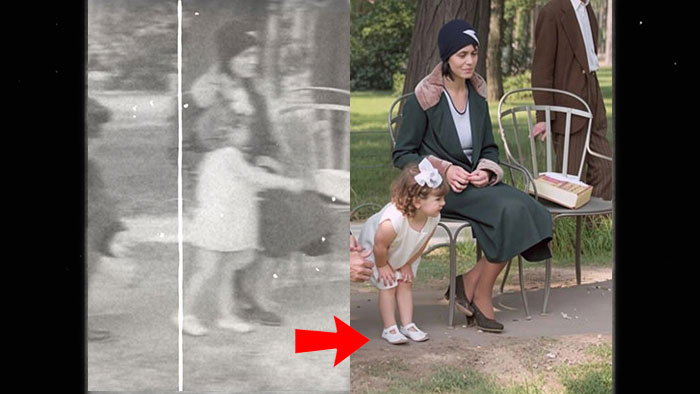
Look at that deep green suit—classic 1930s tailoring with a dropped waist that’s just starting to fall out of fashion. The white collar and cuffs? Pure elegance. And that navy cloche hat perched just so on her head—it’s like she walked straight out of a Vogue illustration. Her little one, meanwhile, is the picture of innocence in her light-coloured dress and Mary Janes, clutching what looks like a toy or perhaps a small bag.
This wasn’t some staged photoshoot. This was just… life. A Sunday afternoon in the park. And now, nearly a century later, you can almost hear the rustle of leaves and the distant sound of children laughing.
The Young Mother with Her Baby: Working-Class Warmth
Here’s where the restoration gets emotional for me. This young Roma woman is carrying her baby wrapped in a soft blue blanket. She’s standing on a bustling Parisian street cafe, reading the palm of a gentleman. No doubt for money.
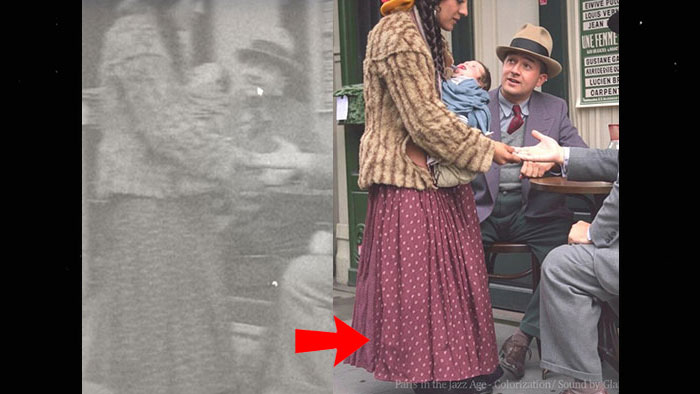
The original footage showed her as just another shadowy figure. But in colour, you can see the warm tones of her coat, the delicate burgundy pattern of her skirt, and—if you look closely—the weary determination in her posture. This wasn’t a wealthy Parisian; this was a working mother, probably on her way to or from the market, juggling motherhood and survival in a city that was equal parts glamour and grit.
The street signs in the background hint at a neighbourhood that’s all business—cafés, shops, the hum of commerce. And yet, in this one frame, there’s such tenderness. It’s a reminder that history isn’t just the grand events or the famous faces. It’s also the quiet, everyday struggles and joys of people like her.
The Woman in Blue: Striding Through Modernity
Now we’re talking. These two woman are striding through the streets with purpose. They’re pushing a cart ahead of them filled with baguettes On the side of the cart it says boulangerie patisserie. A typical morning bread delivery. You can’t get more Parisian than that.
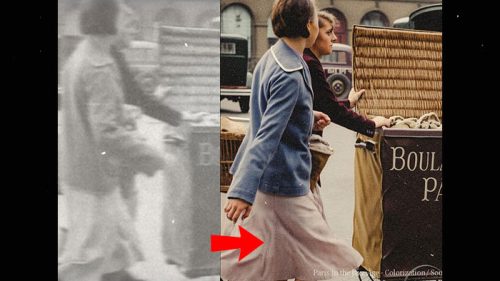
What struck me most about this frame was the life in motion confidence. The way they walked, shoulders back, head held high. Colorizing these frames was like flipping a switch. Suddenly, these two women weren’t just silhouettes. They were real people again.
Paris School Children walking on Cobblestones
This one’s a gem. Two young girls going to school walking down a cobblestone street, and they couldn’t look more carefree if they tried.
A charming moment of childhood we have all experienced, carrying our schoolbags.
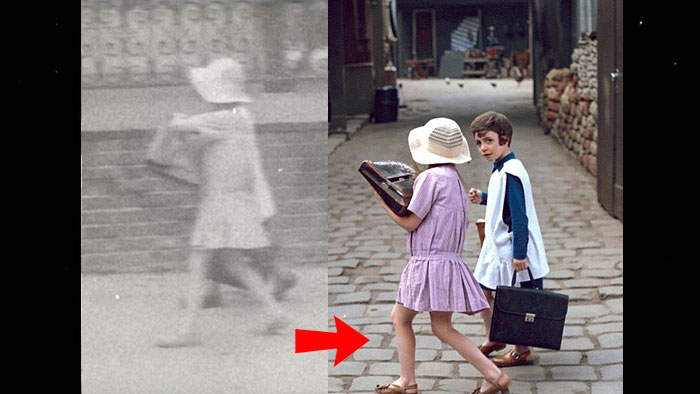
The cobblestones, by the way, were a nightmare to work with. Getting the colour right—that dusty grey with hints of ochre—required diving deep into historical photos of Parisian streets. But it was worth it because now you can almost feel the uneven ground beneath their feet.
The Metro Group: A Kaleidoscope of Hats
Oh, the hats. An extraordinary nun’s habit and the glorious cloche hats and French berets. This shot, taken in what I believe is a Metro station or covered market, is a masterclass in 1930s millinery.
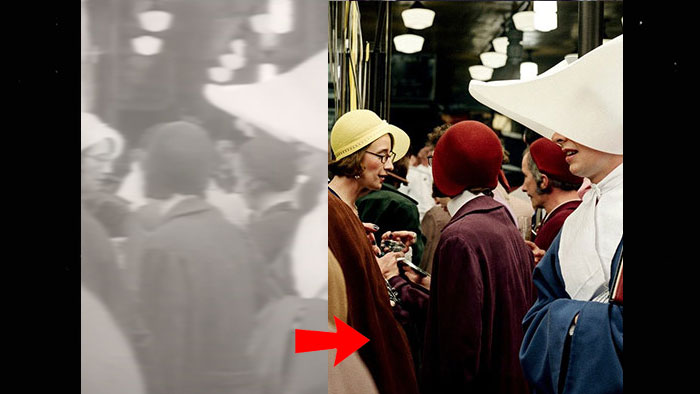
The French beret is more evident by this point, too, signalling that we’re firmly in the 1930s and not the ’20s. The dresses have dropped below the knee, and there’s a certain sobriety creeping in—though you’d never know it from the riot of colour on display here.
Colour-grading this scene was like solving a puzzle. Each hat had to be distinct, each coat had to pop, but nothing could look garish. I referenced dozens of period photos and textile swatches to get the wool tones just right. And when it all came together? Magic.
This is Paris at its most human—people bundled up against the cold, going about their day, their hats like little beacons of personality in the grey urban landscape.
The Nightclub Scene: The Glamour of Jazz Age Paris
And here we are—the pièce de résistance. This is what the Jazz Age was really about: the nightlife, the music, the unapologetic decadence. We’re in a Parisian nightclub, and the dancer in the foreground is dressed to kill in a stunning turquoise and pink ensemble. That turquoise skirt? Silk, probably, and absolutely dazzling. The pink headscarf and matching turban? A bold choice that somehow works perfectly. The choice for music over this footage was obvious – the Rumba ! By 1930, Cuban music was the latest rage in Paris.
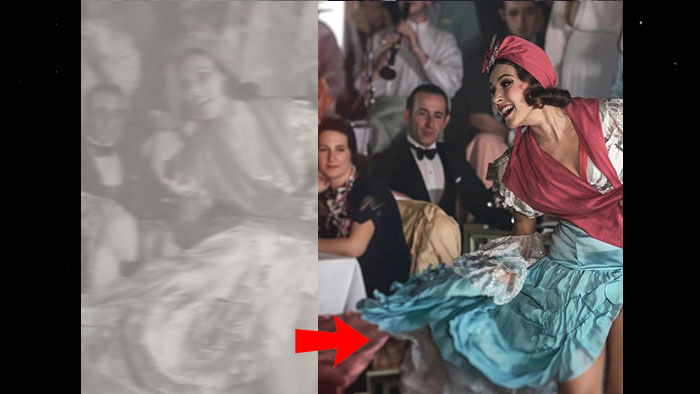
Behind her, the crowd is a blur of tuxedos and evening wear, but she’s the star of the show. There’s something theatrical about her pose, her smile—she knows she’s being filmed, and she’s leaning into it.
Restoring this film sequence was a labour of love. Getting the turquoise to glow without looking like a cartoon, balancing the warm tones of the room with the cool hues of her outfit. This is the Paris of legend: the jazz clubs, the dancers, the sense that anything could happen. It’s a side of the city that was just as real as the working mothers and quiet park benches, and it deserves to be remembered in all its vivid, dazzling glory.
Paris Waiter with the Red Fez c.1930
Ah, now this is a scene worth savouring. We’re at what appears to be an outdoor café or restaurant terrace, and the star of this particular frame is the waiter is a man who clearly understands that service is an art form. He’s wearing a cream-coloured jacket with subtle embellishments and, most strikingly, a deep burgundy fez perched confidently on his head.
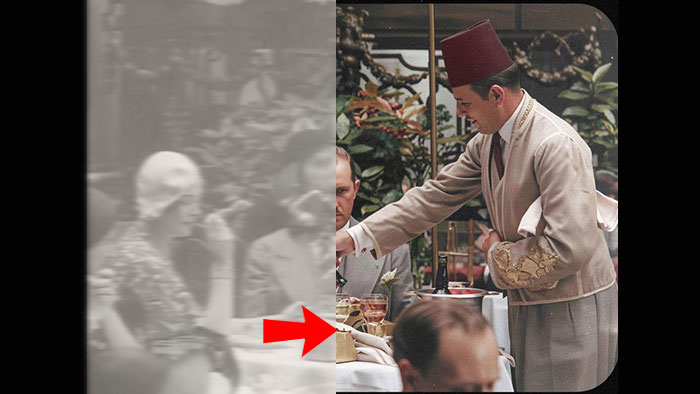
The fez is everything. In 1930s Paris, especially in establishments catering to tourists or those with an “exotic” theme, waiters sometimes wore fezzes as part of their uniform as a nod to the Arabian love affair that were very much in vogue at the time. It’s a complicated bit of history, but there’s no denying the visual impact. That rich, wine-red colour against his pale jacket creates a striking contrast that immediately draws your eye.
In the background, you can see the other diners, elegant patrons enjoying their meal under what looks like an awning or pergola draped with greenery. The whole scene has this wonderfully leisurely quality, like time has slowed down just enough for everyone to enjoy the moment. The waiter is mid-gesture, perhaps explaining a dish or taking an order, and there’s a professionalism to his bearing that speaks to the high standards of Parisian hospitality.
The Glamourdaze Restoration Process: How I Did It
Okay, let’s get into the nitty-gritty. Bringing this footage to life wasn’t just a matter of slapping on some filters and calling it a day. This was a frame-by-frame process that required equal parts historical research, technical know-how, and—let’s be honest—obsessive attention to detail.
Colour-Grading: Using a hybrid of historical research and advanced colour-mapping, I restored the natural palettes of 1930s Paris. This meant poring over period photographs, fashion illustrations, and textile samples to ensure that every shade of blue, every hint of burgundy, was as accurate as possible. The goal wasn’t just to make it look pretty; it was to make it feel right.
Frame Rate Adjustment: The original footage was shot at 20fps, which gives it that jerky, silent-film quality. I adjusted it to a fluid 60fps using frame interpolation, which essentially creates new frames between the existing ones to smooth out the motion. It’s like upgrading from a flip-book to a high-definition movie.
Noise Removal and Upscaling: Old film is noisy—scratches, dust, grain—and while some of that grain is part of the charm, too much of it can be distracting. I used proprietary upscaling techniques to recover lost details while preserving the authentic texture of the original celluloid. It’s a delicate balance: you want it to look sharp without looking plastic.
Sound Design: This was the fun part. Since the original footage was silent, I got to create an entirely new soundscape. I layered in historically accurate ambient city noise—the hum of early Citroëns, the clatter of carriage wheels, the murmur of café conversations—to make you feel like you’re actually there. It’s not just background noise; it’s an immersive experience.
All told, this process took weeks. But seeing these Parisians step out of the shadows and into colour? Totally worth it.
Why This Matters
You might be wondering: why go to all this trouble? It’s just old footage, right?
Wrong. This isn’t just old footage. This is a window into a world that no longer exists. The Paris of 1930 was a city in transition—caught between the exuberance of the Jazz Age and the looming shadow of the 1930s. The people in this film had no idea what was coming: the Great Depression, the rise of fascism, World War II. They were just… living.
By restoring this footage, I’m not just preserving history; I’m making it accessible. Black-and-white film can feel distant, abstract. But colour? Colour makes it real. It reminds us that these weren’t just figures in a history book—they were people with hopes, dreams, and really excellent fashion sense.
And maybe, just maybe, it’ll inspire you to look at your own life differently. Because one day, someone might be restoring your grainy smartphone videos, marvelling at the way you lived, the way you dressed, the way you walked down the street like you owned it.
So here’s to the mother in the park, the woman in the fur-trimmed coat, the confident stride of the lady in blue, the carefree girls on cobblestones, the kaleidoscope of hats, the nightclub queen in turquoise, and the waiter with the burgundy fez. Thanks for letting me bring you back to life.
Until next time, keep time travelling.
That’s all ! © Glamourdaze